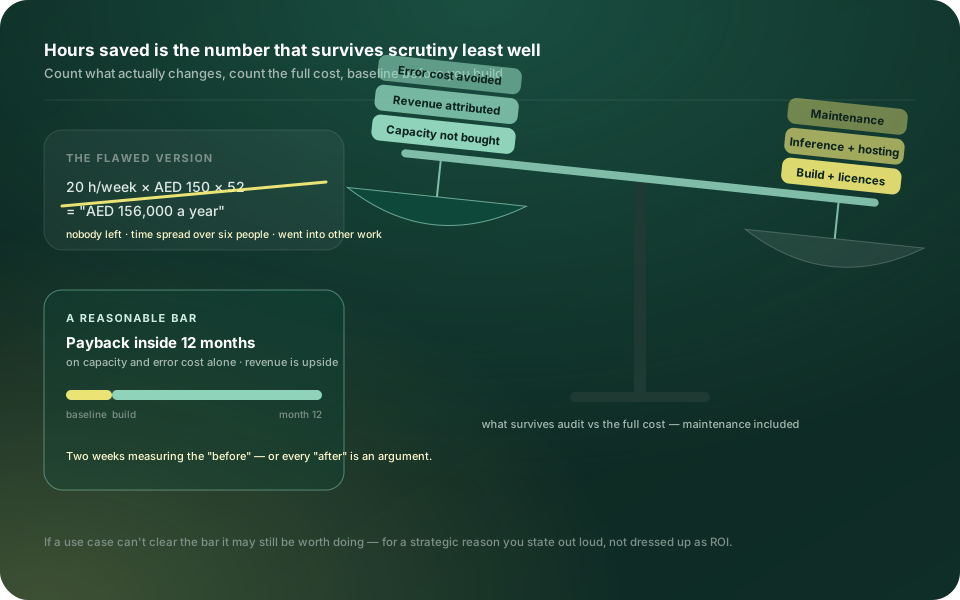
To calculate automation ROI honestly, drop 'hours saved'. Count the three things that survive audit — capacity you did not have to hire, revenue you can attribute to faster response, and error cost you can pull from last year's ledger — against the full cost, including licences, inference, hosting and maintenance. Baseline for two weeks first, and expect payback inside twelve months on capacity and error cost alone.
The flawed version
'This saves 20 hours a week × AED 150/hour × 52 weeks = AED 156,000 a year.' It falls apart on contact: nobody was made redundant, the 20 hours were spread thinly across six people, and the time went into other work rather than to the bottom line.
Count what actually changes
Three things survive audit. Capacity you didn't have to buy — the hire you deferred because the existing team absorbed growth. Revenue you can attribute — faster response converting leads that measurably used to go cold. Error cost avoided — rework, credit notes and penalties you can pull from last year's ledger.
Count the full cost too
Build fee, licences, inference, hosting, maintenance, and the internal time spent on discovery, testing and training. Maintenance is the line most proposals omit and most finance teams ask about first.
Then baseline before you build
Measure the current state for two weeks before anything changes. Without a baseline, every post-launch number is an argument rather than evidence — and the argument is one you'll lose at the next budget cycle.
A reasonable bar
Payback inside 12 months on capacity and error cost alone, treating any revenue effect as upside. If a use case can't clear that, it may still be worth doing — but for a strategic reason you should state out loud rather than dress up as ROI.
Related services
- Workflow & Process AutomationBusiness process automation for the unglamorous wiring: quotes, invoices, approvals, onboarding, reporting — running themselves.
- Data Engineering & DashboardsData analytics and Power BI dashboards: one number everyone trusts, instead of four departments arguing about whose export is right.
Working on this in the UAE right now? We'll give you a straight read on your situation in 30 minutes.
Book a call